8 Best Grains for People With Diabetes
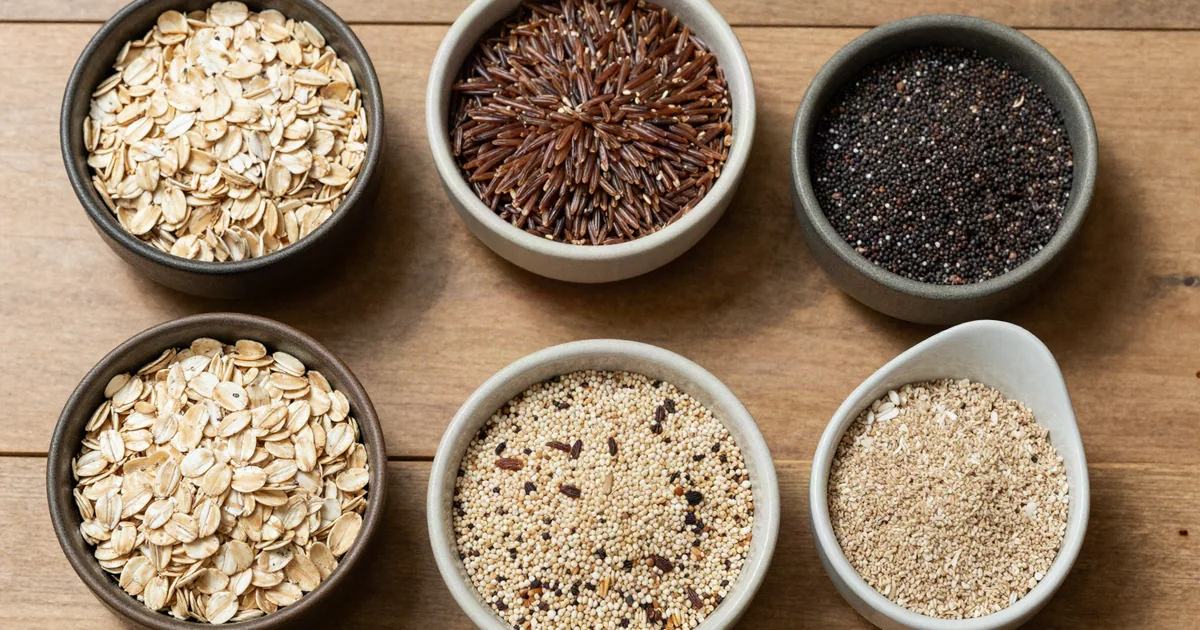
Quick answer: The grains worth your carbs are the ones you can still see: oats, barley, quinoa, farro, buckwheat, bulgur, brown and wild rice, and amaranth, each carrying roughly 4 to 8 grams of fiber per cooked cup. Half a cup of any of them beats two cups of the best one, and that sentence decides your two-hour reading more than the grain name does.
I still eat grains. Rice, bread, oatmeal, all of it, in portions I measured once with a real cup and then learned by eye. My A1C went from 9 to 6.5 and my two-hour readings usually sit under 6 mmol/L, and none of that came from giving up rice. It came from changing what rice sat next to and how much of it was on the plate.
So when a post tells you to cut all grains, understand who wrote it. Somebody who doesn’t have to carry a cooler into a mechanical room at eight in the morning and then drive four more calls.
Are grains allowed with type 2 diabetes?
Yes, and the argument against them is usually aimed at the wrong target. It was never a grain problem, it was a portion-and-shape problem. A cup of cooked grain is 40 to 50 grams of carbohydrate whether it’s the cheapest white rice or the fanciest heirloom farro, and that number is not a rounding error.
Here’s the part people skip. The gap between the “best” grain and the “worst” grain is maybe 20 or 30 percent of the glucose response. The gap between half a cup and two cups is 300 percent. Grain choice changes the shape of the curve. Portion changes the height. You want both, but if you only get one, take the portion.
Which grains are worth the carbs?
Oats
Oats earn their reputation from beta-glucan, the soluble fiber that thickens the pot, about 4 grams per cooked cup, and it slows glucose absorption directly. Steel-cut sits lowest on the glycemic index, around 55, and the sweetened instant packets are a different food in the same box picture, with 12 grams of sugar or more added. I cook steel-cut in a batch on Sunday and reheat it, because at 5:30 a.m. I follow a procedure, I don’t make decisions. More on that in is oatmeal good for diabetes.
Barley
Barley is the best-kept secret on this list and I don’t know why it isn’t louder. About 8 grams of fiber per cooked cup, most of it soluble, with a glycemic index near 28 for pearl barley, the lowest of any common grain. It also survives a slow simmer, so a half cup dumped into any soup thickens the pot and lowers the load of the whole thing at the same time, one fix doing two jobs, like a good shutoff valve.
Quinoa
Quinoa is technically a seed, and it behaves like the best grain you could ask for: about 5 grams of fiber, 8 grams of complete protein per cooked cup, glycemic index around 53. That protein number is why it can hold the middle of a plate without the spike white rice gives me.
Farro
Farro is an ancient wheat with a chewy kernel, and the chewing is the point, because intact kernels digest slower than anything milled fine. About 5 grams of fiber per cooked cup, nutty, low to moderate on the index. It’s wheat, so it’s out if you have celiac disease, and quinoa or buckwheat take its place. Cooked farro with olive oil, lemon and roasted vegetables, made ahead and eaten cold, is a work lunch that survives a hot van.
Buckwheat
Buckwheat isn’t wheat and has no gluten, it’s a seed related to rhubarb, which matters if you’re avoiding gluten and still want something hot and starchy on the plate. A cooked cup gives about 4.5 grams of fiber, 5.7 grams of protein, and a glycemic index in the high 40s. Toasted groats with onions and mushrooms, or a porridge with cinnamon, both work. It’s cheap, which matters when you’re feeding a household and not a food blog.
Bulgur
Bulgur is wheat that’s been parboiled, dried and cracked, which makes it the fastest whole grain here, ten to fifteen minutes in hot water with no cooking at all. A cooked cup has about 8 grams of fiber for roughly 150 calories, tied for the highest fiber on the list. Tabbouleh is the obvious use, and it’s the right one, because the parsley and tomato and cucumber outnumber the grain. When vegetables outnumber the starch, my meter is calm, and that’s the mechanism, not a coincidence.
Brown and wild rice
Brown rice is the swap that sticks for people who eat rice daily, because it keeps the same habit and the same place on the plate while going from under 1 gram of fiber to about 3.5 per cooked cup. Wild rice does better still, around 6.5. Neither is low carb, a cup of either is about 45 grams, so the portion rule does the heavy lifting. I cook a batch, cool it overnight and reheat it, and the cooling converts some starch to resistant starch, which I’ve written about in resistant starch, rice and potatoes.
Amaranth
Amaranth is the small one, and it turns porridge-like instead of fluffy, so treat it as a breakfast grain and stop expecting it to be couscous. About 5 grams of fiber per cooked cup, real calcium for a grain, plus magnesium and iron, gluten-free, glycemic index in the low 50s. Simmer it with milk, cinnamon and berries and it eats like a treat without pretending to be one.
Does how you cook it change the number?
More than the grain choice does. A whole kernel digested as a kernel is slow. The same grain ground into fine flour is fast, because a machine did the chewing. That’s why a dense whole-grain bread can hit me harder than a boiled pot of barley.
Three things move the number without changing the food. Cook it less, so it stays firm. Cool it, then reheat it. And eat it with protein and fat, because a bowl of rice alone and the same bowl next to chicken are two different events.
How much is a portion?
Half a cup cooked, measured once with an actual measuring cup, because every eyeball on earth undercounts by half. Then test at one and two hours and adjust from your own numbers instead of mine. Vegetables and protein fill the rest of the plate, and the grain is the smallest quarter of it. Protein, fat and fiber all slow the stomach down, which is the whole mechanism.
What if I have kidney disease too?
Then the grain list gets a second filter, and it isn’t my filter to set. Whole grains carry potassium and phosphorus, and with stage 3b CKD the amount that’s fine depends on your labs, not on a grain ranking. I have CKD too, my eGFR improved, and I still don’t pick my grains off a blog. That’s a dietitian conversation, and a better one when you bring your last three lab sheets.
When to call your care team
If your two-hour reading after a grain meal is consistently above 10 mmol/L, or your fasting number climbs for two weeks straight while nothing else changed, bring the log in. If you’re on insulin or a sulfonylurea, a big change in grain portions can change what you need, and that’s a dosing conversation, not a menu one.
General information, not medical advice. Fiber, carb and glycemic numbers are averages that shift with variety and cooking, so test your own response and set targets with your care team.
Frequently asked questions
Are grains allowed with type 2 diabetes?
Yes, and the argument against them is usually aimed at the wrong target. It was never a grain problem, it was a portion-and-shape problem.
Which grains are worth the carbs?
### Oats Oats earn their reputation from beta-glucan, the soluble fiber that thickens the pot, about 4 grams per cooked cup, and it slows glucose absorption directly.
Does how you cook it change the number?
More than the grain choice does. A whole kernel digested as a kernel is slow. The same grain ground into fine flour is fast, because a machine did the chewing.
How much is a portion?
Half a cup cooked, measured once with an actual measuring cup, because every eyeball on earth undercounts by half. Then test at one and two hours and adjust from your own numbers instead of mine.
What if I have kidney disease too?
Then the grain list gets a second filter, and it isn't my filter to set. Whole grains carry potassium and phosphorus, and with stage 3b CKD the amount that's fine depends on your labs, not on a grain ranking.
Want the complete system?
This guide is based on Hardy's ebooks — plain-language, step-by-step PDFs you can read in one sitting. See all guides
Educational content only — not a substitute for advice from your doctor or pharmacist. Always work with your care team.