Coffee and Blood Sugar: What Actually Happens
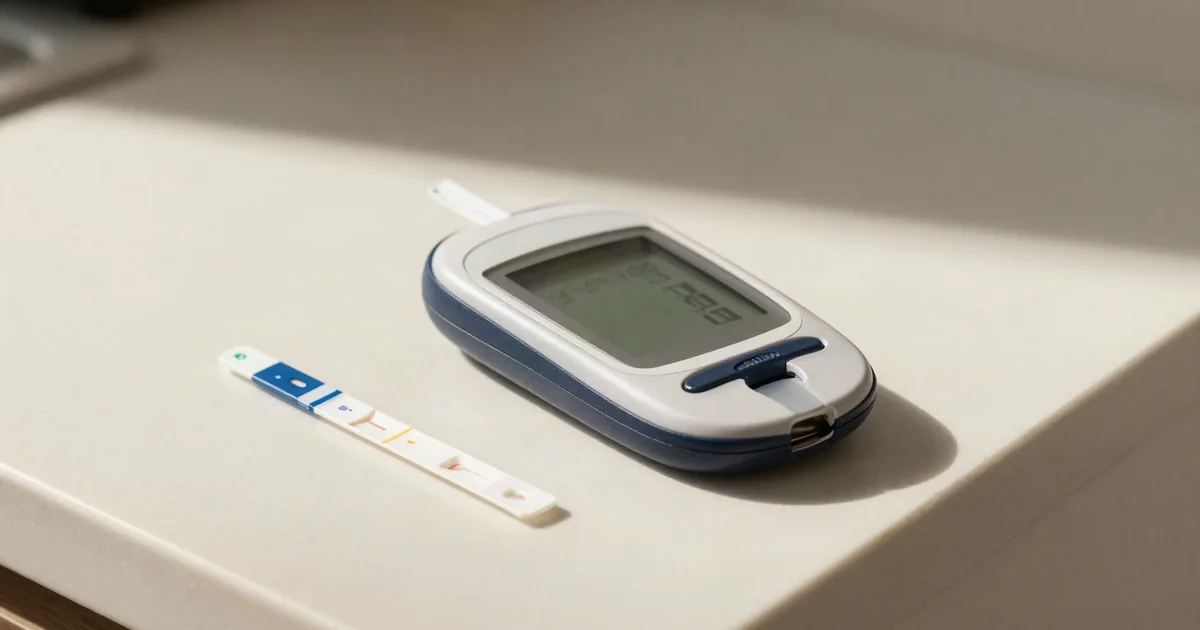
Quick answer: Black coffee on its own has almost no carbohydrate in it, so it barely moves most people’s glucose, and the long-term studies actually lean slightly in coffee’s favour. What spikes the morning number is what goes in the cup: the syrup, the flavoured creamer, the sweetened oat milk, the whipped topping.
I drink my coffee black and I’ve watched the meter before and after enough times to have an opinion. Some mornings the number sits still. Some mornings it drifts up eight points before I’ve eaten anything, coffee or no coffee.
Both are real, and neither one is the coffee being bad for me. “Does coffee raise blood sugar” gets answered as one question when it’s really three.
Does coffee raise blood sugar?
Short answer: a little, sometimes, for some people, for an hour or two.
Caffeine is a stimulant, and a stimulant gets your body’s alarm system going. Adrenaline rises, the liver lets go of some stored glucose, and your meter sees it. It’s the same response as being startled, just gentler and slower. Modest, and usually fading inside two hours.
Long answer: over years, regular coffee drinking is associated with a lower risk of developing type 2 diabetes in large population studies, and researchers think it’s the chlorogenic acids and other plant compounds rather than the caffeine. Association isn’t proof, and people who drink black coffee differ from people who drink triple-caramel lattes in about forty other ways.
So the honest summary is “probably neutral to mildly helpful long term, mildly bumpy short term, and the bump is not a reason to quit.”
The test that matters is yours. Same breakfast, two days, one with coffee and one without, and check your two-hour number. I check two hours after eating because that’s the number that tells me how a meal actually landed, and it’s the one I’ve moved from the high sevens down under 6 mmol/L with walking. Do the test three or four times before you conclude anything, because one reading is a mood, not a measurement.
What is actually in the cup?
This is where the real damage lives, and it’s almost never the coffee.
Black coffee is essentially zero carbohydrate. Everything people blame on “coffee” is in the add-ins:
- Flavoured creamers, liquid or powder, are usually built on sugar, corn syrup or refined oil. A few generous pours can add 10 to 20 grams of carbohydrate before you’ve eaten anything.
- Flavoured syrups. One pump is real sugar, and a large café drink regularly carries four pumps or more.
- Sweetened plant milks. Oat milk in particular is fast carbohydrate, and a lot of the barista versions are pre-sweetened on top of that.
- Whipped cream and drizzle on the seasonal drinks, which are dessert with a coffee label.
If that’s your daily order, you’re not drinking coffee with breakfast. You’re drinking a small dessert and then eating breakfast. That’s the reclassification: the problem was never the bean, it was the build sheet.
Fix it without giving anything up:
- Order it black, and if black is too bitter, wean down over two or three weeks instead of overnight. Your tongue adjusts; it just needs a runway.
- Use plain cream or whole milk in a measured amount, not a pour. A tablespoon of cream is about half a gram of carbohydrate; three unmeasured is a different drink.
- Choose unsweetened plant milk and read the carton, because “oat” and “barley” are the highest carb of the bunch.
- Flavour with cinnamon or a drop of vanilla extract instead of syrup. Not identical, close enough to stop noticing after a week.
That’s one change, made once, and it holds as long as you keep ordering it.
Why does my number rise before I eat anything?
Two things are happening at once and they overlap, which is why the pattern is so confusing to look at on a graph.
First, the dawn phenomenon, in the early morning your body releases cortisol and growth hormone, and those tell the liver to let go of glucose so you have fuel to wake up with. Everybody gets it. With type 2 diabetes it can show up as a higher fasting number than you went to bed with, and no, you didn’t do anything wrong.
Second, caffeine pushes on the same lever. Cortisol and caffeine both nudge the liver toward releasing stored glucose, and they arrive at the same hour of the morning. That’s why some people see a visible bump from coffee-plus-morning and some people see nothing at all, the two effects stack, and how tall the stack is depends on the person.
What I’d watch is size and duration. A small bump that flattens by mid-morning is your body being a body. A large rise that stays up until lunch is worth bringing to your care team, because that’s a pattern, and patterns can be worked with.
Why the morning number runs high has the mechanism in more detail.
Does when I drink it matter?
Yes, and it’s the cheapest thing to change.
Coffee on an empty stomach gives you the biggest caffeine hit and, for a lot of people, the biggest bump. If that’s your pattern, drink it with or after breakfast instead of before, and watch the same day’s numbers.
Coffee after a carb-heavy breakfast stacks the caffeine peak on top of the meal peak, and that’s the morning where the meter looks worst and you blame the toast.
Late coffee mostly wrecks sleep, and lousy sleep raises tomorrow’s numbers more than the coffee did. My last cup is early afternoon, and the difference in my morning fasting reading after a bad night is bigger than anything coffee ever did.
One more: eating order matters too. Vegetables and protein before the starches gives a flatter curve, and coffee alongside a protein-forward breakfast behaves better than coffee alone. Carbs last, protein first is the method if you want it.
And if you take blood pressure medication, remember caffeine lifts pressure for a couple of hours, coffee and blood pressure readings covers that side, and the right amount of caffeine for you is a question for your care team, not a blog.
What is the best order, worst order?
Best to worst:
- Black coffee, hot or iced, nothing in it.
- Espresso or americano, plain.
- Cold brew, unsweetened, smoother and usually less of a jolt.
- Coffee with a splash of plain cream or unsweetened almond milk.
- A latte with unsweetened milk, note a large one still carries real carbohydrate from the milk.
- One pump of syrup, or sweetened oat milk. Occasional, not daily.
- Flavoured powdered creamer.
- Large flavoured latte, multiple pumps, whipped topping.
- Blended frappé and seasonal specialty drinks. Milkshakes with a coffee label.
If you’re at eight or nine every morning, moving to four is one of the easiest wins on the board, and you keep the coffee. Nobody has to take anything away from you.
When to call your care team
Call if your morning readings are consistently higher after coffee than before it, week after week, or if a first cup sends you over your usual range and it stays there past mid-morning. Call sooner if coffee gives you palpitations, chest tightness or a pounding headache, or if your blood pressure is spiking after your usual cup. And if you’re on insulin or a sulfonylurea, don’t change your morning routine around coffee without asking, timing affects the dose, and the dose isn’t a blog decision.
General information, not medical advice. Your caffeine limit, your targets and your medication timing come from your care team, who know your kidneys and your blood pressure as well as your sugar.
Frequently asked questions
Does coffee raise blood sugar?
Short answer: a little, sometimes, for some people, for an hour or two. Caffeine is a stimulant, and a stimulant gets your body's alarm system going.
What is actually in the cup?
This is where the real damage lives, and it's almost never the coffee. Black coffee is essentially zero carbohydrate. Everything people blame on "coffee" is in the add-ins: Flavoured creamers, liquid or powder, are usually built on sugar, corn syrup or refined oil.
Why does my number rise before I eat anything?
Two things are happening at once and they overlap, which is why the pattern is so confusing to look at on a graph.
Does when I drink it matter?
Yes, and it's the cheapest thing to change. Coffee on an empty stomach gives you the biggest caffeine hit and, for a lot of people, the biggest bump.
What is the best order, worst order?
Best to worst: Black coffee, hot or iced, nothing in it. Espresso or americano, plain. Cold brew, unsweetened, smoother and usually less of a jolt.
Want the complete system?
This guide is based on Hardy's ebooks — plain-language, step-by-step PDFs you can read in one sitting. See all guides
Educational content only — not a substitute for advice from your doctor or pharmacist. Always work with your care team.