Resistant Starch: Rice and Potatoes on Blood Sugar
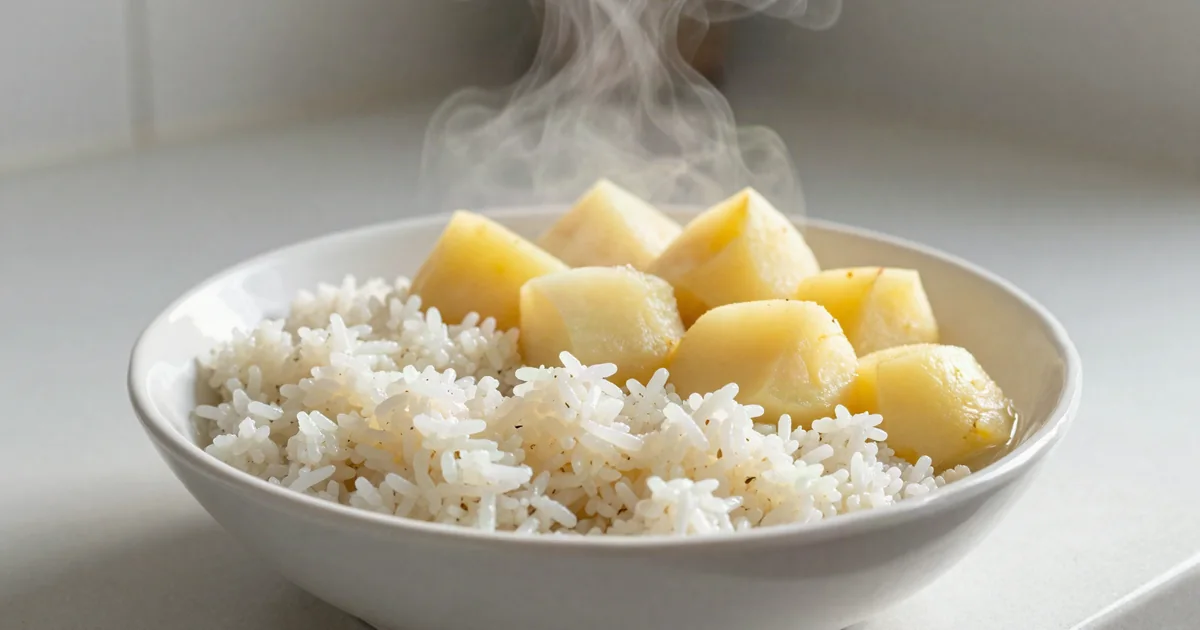
Quick answer: Cook the rice or potatoes, put them in the fridge overnight, reheat them the next day, and part of the starch has turned into resistant starch, a shape your small intestine cannot break down, so the glucose arrives slower. It flattens the spike, it does not delete the carbohydrate, and it costs you one night of fridge space.
My A1C was 9 and it’s 6.5 now, and I did that by walking after meals and reading every label before I order, not by banning rice from the house. So when somebody tells me there’s a trick that makes rice behave better, I’m interested but I’m not excited, because I’ve been sold a lot of tricks.
This one is real, and it’s small, and the edge of it matters more than the trick.
What does resistant starch actually mean?
Most of the starch on your plate moves quickly. Your small intestine breaks it into glucose, the glucose goes into your blood, and the meter climbs, that’s the event, that’s all that’s happening, it’s a plumbing problem in the simplest sense.
Resistant starch doesn’t get broken down there. It passes further down the pipe and lands in the colon, where bacteria ferment it, and much less of it ever shows up as fast glucose. MedlinePlus groups it with fiber for exactly that reason, it behaves like fiber because, functionally, it is fiber (MedlinePlus).
So it’s not a different food. It’s the same potato, the same scoop of rice, sitting in a shape your gut can’t open. That’s the whole idea, and once you see it that way the rest is just kitchen procedure.
Why does the fridge change anything?
Heat does the damage first. When you boil rice or a potato, the heat pushes water into the starch granules and opens them up, and in that open state your enzymes have full access. Everything gets converted fast, which is why fresh white rice hits hard.
Then it cools. And when it cools, some of that opened starch pulls back together into a tighter crystal, food scientists call it retrogradation, I call it the starch setting like a joint of pipe after the glue dries, and those crystals are hard for your enzymes to get at.
The part that surprised me is that reheating doesn’t undo it. You cook it, you chill it, you heat it back up, and most of the new structure holds.
The numbers are modest but real. In one small crossover study, white rice that was cooked, chilled for 24 hours and reheated produced a significantly flatter glucose response than the same rice eaten fresh, and its resistant starch had roughly doubled from about 0.6 to 1.7 grams per 100 grams (PubMed). Doubled sounds dramatic until you see the actual grams. That’s the honest scale of this: a small effect, measured, repeatable.
Do rice and potatoes behave the same way?
No, and this is where most articles oversell it.
Rice is the strongest case. Cool it, reheat it, and you keep most of what the cooling built. Pasta behaves close to rice, which is why pasta salad the next day is a better plate than people expect.
Potatoes are softer. Cooling raises the resistant starch, and chilled potato eaten cold did lower glucose and insulin responses in one trial, but reheating gives back a chunk of what the cooling created, so the net is less than rice. Cold potato salad keeps more of the benefit than a reheated baked potato (PMC).
So the trick works everywhere and works hardest on rice. If you only change one thing, change the rice.
Which foods already have it built in?
Some foods don’t need the cook-and-cool cycle at all.
- Slightly green bananas, the greener, the more resistant starch, and it drops as they ripen on the counter
- Beans and lentils, naturally high, which is one more reason they sit calmly on a plate
- Oats, especially soaked or cooled oats, which is the overnight oats argument without the hype
- Cooked and chilled pasta, the pasta salad case again
Look at the pattern: whole starches, cooked gently, cooled before eating. Nothing exotic, nothing from a shelf with a health claim on it. If the rice question is still open for you, what happens when a diabetic eats rice covers the portion side of it.
And if you’re wondering whether the walking really carries that much of the load, more than any kitchen trick, why a walk after dinner moves the morning number is the honest version of that argument.
How do I run this without adding work?
You need a fridge shelf, not a protocol.
- Cook rice on Sunday and portion it into containers. Same pot, same time, same effort, you’ve just moved the eating to a different day. Reheat portions through the week.
- Make potato salad the default side. Boil, chill overnight, dress cold with oil and vinegar. The vinegar is not decoration; acid slows the meal down too.
- Reheat with a splash of water, not a long fry. Microwave or steam it back to temperature. A hard fry in oil undoes some of the texture work and adds a load of fat you didn’t need.
- Shift one breakfast to overnight oats. Soak them in the fridge, eat them cold, and you get the cooled-starch effect without thinking about it again.
The food-safety part is not optional: get cooked rice and potatoes into the fridge within an hour or two, not on the counter overnight. Cooked starch left warm is a genuine Bacillus cereus setup, and that’s a bad night you don’t need to earn.
So what did it do for my numbers?
Honestly? Not much on its own.
I went from 232 lb to about 208, and from 9 to 6.5, and the thing that moved my after-meal readings was walking after every meal, 10,000 steps a day, broken into pieces, rain or not. That’s the change that did the work. This is a trim adjustment on top of that, worth maybe a point or two of curve height, and if I’m honest with you, my two-hour number under 6 mmol/L came from the walking, not the fridge.
Which is the reclassification I’d offer you: it’s not a hack, it’s a portion of a method. The method is walk, portion, pair with protein. This is the pair-with-protein part getting a small assist.
What it will not do
- It doesn’t make fried food safe. Cook-cool-reheat a chip and you still have a chip.
- It doesn’t remove the carbs. A cup of rice is a cup of rice. Portion still beats preparation, every time.
- It doesn’t change your medication plan. If you take insulin, a slower curve changes when you go up and can change your hypo risk. That’s an appointment conversation, not a kitchen decision.
- It isn’t for every kidney. If your care team has you watching potassium, rice and potatoes are a potassium conversation first, starch trick second.
When to call your care team
Call if your two-hour readings stay high for a week of eating the same plate, if you take insulin or a sulfonylurea and your after-meal numbers drop lower than usual, or if you get bloating and cramping that doesn’t settle after a few days of cooled starches, some guts don’t like the extra fermentation and that’s worth saying out loud. Get help fast for vomiting you can’t keep fluids down with, or a reading that keeps climbing and won’t come down.
General information, not medical advice. My numbers are mine. Your targets, your medication and your kidney restrictions come from your care team, not from a blog.
Frequently asked questions
What does resistant starch actually mean?
Most of the starch on your plate moves quickly. Your small intestine breaks it into glucose, the glucose goes into your blood, and the meter climbs, that's the event, that's all that's happening, it's a plumbing problem in the simplest sense.
Why does the fridge change anything?
Heat does the damage first. When you boil rice or a potato, the heat pushes water into the starch granules and opens them up, and in that open state your enzymes have full access.
Do rice and potatoes behave the same way?
No, and this is where most articles oversell it. Rice is the strongest case. Cool it, reheat it, and you keep most of what the cooling built.
How do I run this without adding work?
You need a fridge shelf, not a protocol. Cook rice on Sunday and portion it into containers. Same pot, same time, same effort, you've just moved the eating to a different day.
So what did it do for my numbers?
Honestly? Not much on its own. I went from 232 lb to about 208, and from 9 to 6.5, and the thing that moved my after-meal readings was walking after every meal, 10,000 steps a day, broken into pieces, rain or not.
Want the complete system?
This guide is based on Hardy's ebooks — plain-language, step-by-step PDFs you can read in one sitting. See all guides
Educational content only — not a substitute for advice from your doctor or pharmacist. Always work with your care team.