What I Eat in a Day with Type 2 Diabetes
Quick answer: Black coffee and eggs in the morning, then protein out of a cooler in the van all day, then one dinner inside a fixed window with the carbs eaten last. I walk after every meal, and that walk is the single change that moved my post-meal numbers more than any food I added or removed.
I’m 43, I install and repair water filtration systems, and my day runs 12 to 16 hours on my feet and up and down stairs, so I’m not handing you a meal plan that assumes a kitchen at noon. My A1C was 9 and it’s 6.5 now. My weight went from 232 lb to about 208, the goal is 180, and I’m not there yet.
People ask what a day looks like, and I’d rather show one with the reasons attached, because the reasons are the part that travels. It’s not a diet, it’s a schedule with food in it. That took me two years to learn.
What does the morning look like?
Black coffee first. No sugar, no cream, no “just a splash” of the flavoured stuff that quietly carries ten grams. Coffee doesn’t move my number. The stuff that goes in it does.
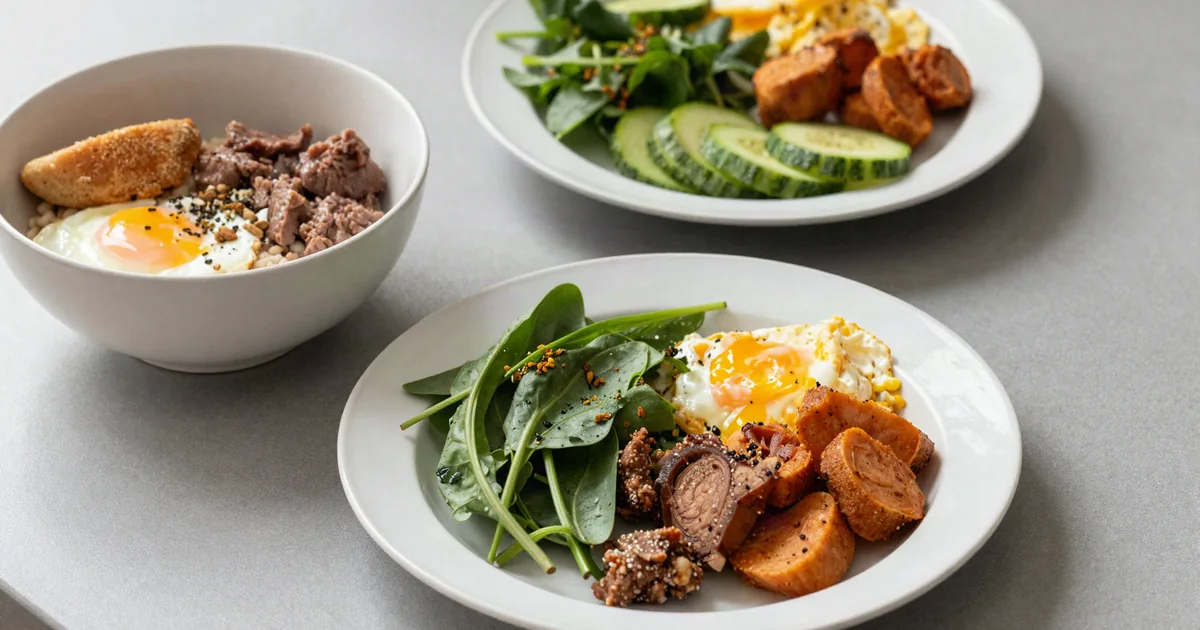
Then eggs, two or three, however they come out of the pan, sometimes with spinach or tomato, sometimes plain. Eggs are almost no carbohydrate and they hold me until lunch, which is the job. Morning is when I’m most insulin resistant, so cereal or juice at 6 a.m. is the worst trade available, and I made that trade for years.
I eat breakfast, and I know intermittent fasting works for some people with type 2. That’s a separate strategy with its own tradeoffs and a conversation to have with a doctor. Eggs work for my mornings and my meter, so eggs it is.
Here’s the part I want you to actually hear. I don’t eat cereal, juice, toast with jam, or granola, including the ones sold as healthy. Not because they’re evil. Because they cost me a spike before 9 a.m. and I’ve spent that money and didn’t enjoy the purchase.
What’s in the cooler?
I eat out of a cooler in the van, and I’ll be honest about why that started. For years it was fast food, and not because I was lazy, because when you’re on the road with twenty minutes between calls, the drive-through is the only thing that fits. Access, not character. That distinction matters to me, and it’s why I don’t moralize about food to anyone.
Now the cooler has the same idea in it, cheaper and slower. Almonds in a small bag, not the family bag, because the family bag is a portion that lies. Cheese. Leftover chicken and vegetables from the night before, which beat any sandwich I’ve bought, because the bread was the problem the whole time.
My rule is one line long: if it has an ingredient list, I don’t eat it. Chicken has no ingredient list. An apple has no ingredient list. A granola bar has eleven lines and three of them are sugar with different names.
I run about 1,400 to 1,500 calories a day, which sounds small on paper and feels fine in a van when the food has protein in it. When lunch does include carbs, I eat the vegetables and protein first and the carbs at the end, which is the eating order trick and it’s free.
What’s dinner?
Dinner happens inside a window, early enough that my last bite lands a few hours before bed, and then the kitchen closes. No grazing from six to ten. No “just one square” of chocolate, which has never once been one square.
On the plate: protein the size of my palm, vegetables as the biggest section, and rice or potato in a modest portion eaten last. I did not cut rice out of my life. I moved it to the end of the meal and shrank it, and that rearrangement is why I’ve kept this up for years instead of three weeks. The longer version of the window is in the dinner window post.
Then I walk. Ten or twenty minutes, not a workout, not shoes I have to think about. Moving muscle pulls glucose out of the blood, so the spike from the rice gets used by the same legs that carried me up four flights that morning.
Why the walk after every meal?
Because it’s the cheapest thing I do and it works better than anything I’ve bought. I walk 10,000 steps most days just from the job, and I still walk after meals, including after lunch when I look like a man pacing in a parking lot. I am a man pacing in a parking lot.
Before the walks, my two-hour readings after dinner were often in the 8s and 9s. After a few weeks of walking every meal, they were mostly under 7, and now they’re usually under 6. Same food, mostly. Same body. The difference was ten minutes of walking and the order I ate in.
I’m not going to dress that up as a discovery. It’s the most boring intervention in this disease, and it’s the one I’d keep if I could only keep one. There’s more on the mechanics in after-dinner walks.
What does the day actually do to my numbers?
Fasting is 4 to 5 mmol/L in the morning. Two hours after eating it’s usually under 6. My A1C is 6.5, down from 9. Those aren’t numbers I’m bragging about, they’re numbers I paid for with about a thousand ordinary days, and they moved in months, not weeks.
I also have high blood pressure and CKD, and my eGFR has improved, which I put down to the sodium, the walking and the weight, in some order I can’t prove. I don’t take medication at the moment, which is a decision made with my care team and reviewed with lab work. If you’re on medication, you don’t change it because of a blog post, you change it with the person who prescribed it.
What I do is check everything against my own data. Not against a study, not against a guy on YouTube, against my meter and my lab sheet. If a food doesn’t behave in my body, it doesn’t matter how good the study was.
What about the days it falls apart?
They happen. I eat fast food, I eat at a restaurant, I have dessert, and I don’t restart on Monday because Monday is a fiction. The next meal is the reset. Not the next day. The next meal.
One off-plan meal is noise. Fourteen of them in a row is a pattern, and the difference between those two things is the only discipline I actually need. Beating myself up never once lowered a reading, and I’ve tested that thoroughly.
When to call your care team
If you’re losing weight without trying, if your readings swing between very high and low, if your feet or vision change, or if you’re on insulin or a sulfonylurea and eating differently is changing your numbers, call them. Those are their calls, not mine. If you have kidney disease, any big change in protein or carbs should go through your dietitian, because the limits change with your labs.
And if you take medication, do not stop it because a stranger on the internet with a good A1C did. Talk to the person who prescribed it.
General information, not medical advice. My numbers are mine and not a target for anyone else, so set yours with your care team and test your own response.
Frequently asked questions
What does the morning look like?
Black coffee first. No sugar, no cream, no "just a splash" of the flavoured stuff that quietly carries ten grams.
What's in the cooler?
I eat out of a cooler in the van, and I'll be honest about why that started. For years it was fast food, and not because I was lazy, because when you're on the road with twenty minutes between calls, the drive-through is the only thing that fits.
What's dinner?
Dinner happens inside a window, early enough that my last bite lands a few hours before bed, and then the kitchen closes.
Why the walk after every meal?
Because it's the cheapest thing I do and it works better than anything I've bought. I walk 10,000 steps most days just from the job, and I still walk after meals, including after lunch when I look like a man pacing in a parking lot.
What does the day actually do to my numbers?
Fasting is 4 to 5 mmol/L in the morning. Two hours after eating it's usually under 6. My A1C is 6.5, down from 9.
What about the days it falls apart?
They happen. I eat fast food, I eat at a restaurant, I have dessert, and I don't restart on Monday because Monday is a fiction.
Want the complete system?
This guide is based on Hardy's ebooks — plain-language, step-by-step PDFs you can read in one sitting. See all guides
Educational content only — not a substitute for advice from your doctor or pharmacist. Always work with your care team.