Berberine, Cinnamon & Apple Cider Vinegar: The Evidence
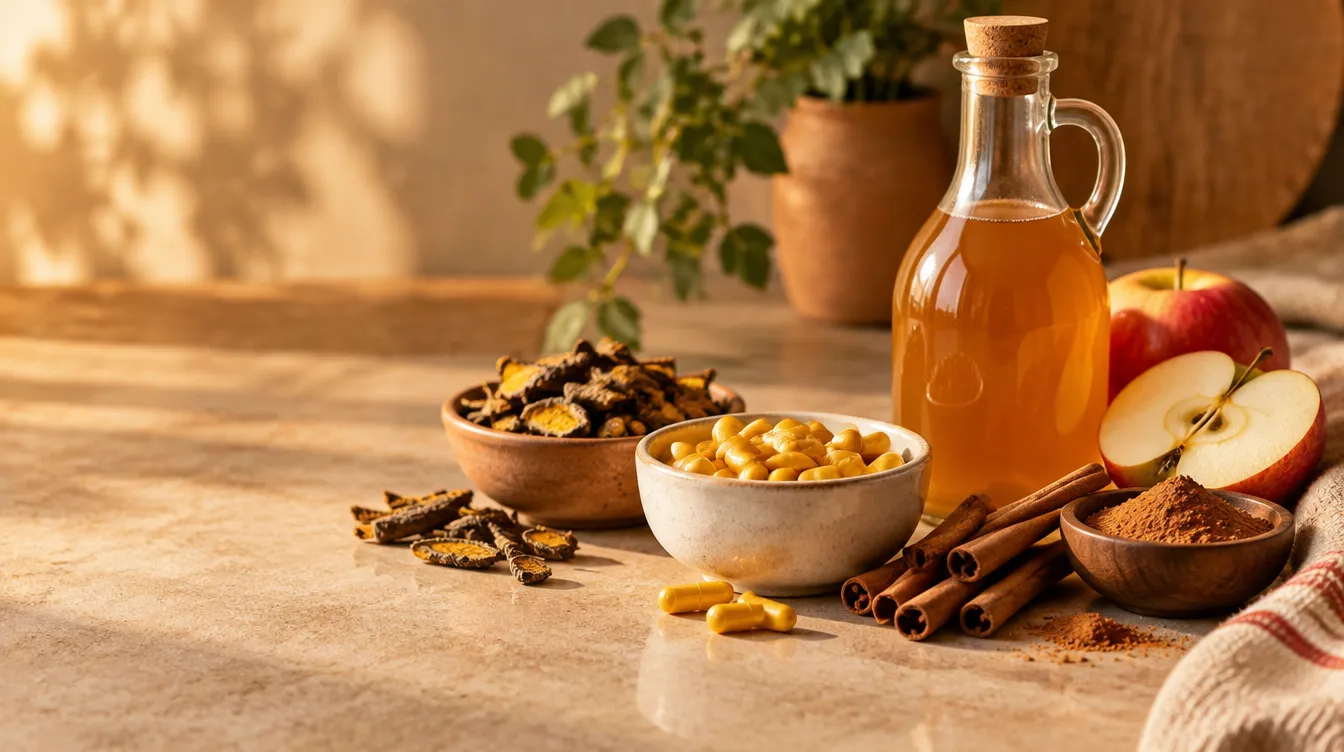
Quick answer: All three have modest real evidence — and none is a treatment. Berberine has the strongest trials (A1c drops around 0.5–1 point in some studies — but with real caveats: quality control, interactions, and digestive side effects). Cinnamon shows small, inconsistent effects; Ceylon cinnamon is the safer variety for regular use. Apple cider vinegar shows a small blunting effect on post-meal glucose in small studies. If any of them “works like metformin” as the ads claim, remember metformin is a studied, standardized prescription drug — supplements are neither. The order of operations is unchanged: diet pattern, movement, sleep, prescribed medication — then, if you still want them, supplements with your pharmacist’s input.
These three own the “natural blood sugar” search world. Here’s what the actual trials say about each — including the parts the supplement pages leave out.
Berberine: the strongest evidence, the biggest caveats
Berberine is a plant alkaloid used in Chinese and Ayurvedic medicine, and its trial record is genuinely interesting: meta-analyses of small-to-medium trials report A1c reductions in the 0.5–1 point range in people with type 2 diabetes, plus modest effects on lipids. The proposed mechanism (AMPK activation) overlaps with metformin’s — which is where the “nature’s Ozempic/metformin” marketing comes from.
The caveats that matter:
- Trial quality is mixed — small samples, short durations, variable dosing, publication bias toward positive results.
- Product quality is the wild west. Independent testing has repeatedly found berberine supplements varying wildly in actual content. You’re trusting the brand, not the molecule.
- Real interactions. Berberine interacts with several medication pathways (it inhibits CYP3A4 and CYP2D6) — cyclosporine, some statins, blood thinners, and more. This is a pharmacist conversation, not a label read.
- Digestive side effects — cramping, constipation, diarrhea are common enough to be a standard finding.
- Not for pregnancy, and caution with kidney or liver disease.
Honest landing: the most evidence-backed of the three, still a supplement — with a real interaction profile that earns a pharmacist check.
Cinnamon: small effects, inconsistent trials
Cinnamon’s blood sugar evidence is a decade of small trials with mixed results — some showing modest fasting glucose improvements, meta-analyses concluding the effect is small and inconsistent across studies. Two practical notes:
- Variety matters. Most grocery “cinnamon” is cassia, which contains coumarin — harmless in kitchen quantities, but a liver concern at regular high-dose supplement levels. Ceylon cinnamon (“true” cinnamon) has far less coumarin and is the safer choice for daily use.
- The effect, where seen, is small — a fraction of what the eating pattern achieves, and nothing like medication.
Honest landing: safe enough as a spice and in Ceylon form, cheap, pleasant — but expect little measurable change, and don’t let a cinnamon capsule substitute for the plate.
Apple cider vinegar: the most modest, the most harmless
ACV’s evidence is a handful of small trials: a modest reduction in post-meal glucose when taken before carbohydrate meals (the proposed mechanism is delayed gastric emptying and an enzyme effect), with effects measured in small numbers. The practical version:
- 1–2 teaspoons in a large glass of water before meals — never straight (it’s acidic enough to damage tooth enamel and irritate the throat).
- The effect is real but small — our vinegar note in the eating-order guide calls it a sidekick, not an engine. A vinaigrette starter does the same job with dinner attached.
- Interactions are minor but real — it can theoretically add to medications that lower potassium or slow digestion.
Honest landing: the least impressive evidence, the least risk, and the tastiest delivery (salad dressing). Fine as a habit; pointless as a strategy.
The order of operations that actually moves glucose
Supplements enter last for a structural reason: their effect sizes are smaller than the basics, and the basics are free. The sequence that works:
- The insulin resistance eating pattern — protein anchored, intact carbs rationed, overnight break.
- Post-meal walks and muscle — the movement levers.
- Prescribed medication, taken as designed.
- Then supplements — chosen with your pharmacist, one at a time, with readings before and after, so you can measure whether your chosen one does anything for you.
That last point is the n=1 discipline the whole site runs on: if you try berberine or cinnamon, test the before-and-after honestly. Supplements that survive your own meter get to stay.
How to run an honest n=1 supplement trial
If you try any of the three, the experiment is worth doing properly — otherwise you’ll spend months on a bottle and a feeling:
- Baseline first. Two weeks of fasting readings and a handful of post-meal readings, no supplement. That’s your control.
- One variable. Start the supplement; change nothing else for 3–4 weeks. If you also start walking after dinner the same week, you’ll never know which one moved the number.
- Compare like to like. Same meals, same sleep as baseline — the fasting trend and a few matched post-meal readings are the scoreboard.
- Judge the trend, then decide. No visible difference? Stop — that’s a successful experiment, not a failed one. A real, repeatable improvement in your readings? That’s a supplement that earned its place, pending your pharmacist’s sign-off on interactions.
- Berberine specifically: a pharmacist check is non-negotiable before combining it with statins, blood thinners, cyclosporine, or anything else you take daily — its interaction profile is real.
This discipline costs nothing and it’s the difference between a supplement habit and a supplement story.
The marketing red flags worth naming
The supplement industry around blood sugar has its own vocabulary, and knowing the tells saves money:
- “Works like metformin/Ozempic” — mechanisms may overlap; evidence standards don’t. Prescription drugs survive randomized trials, standardized manufacturing, and post-market surveillance. Supplements don’t have to survive any of that.
- “Clinically proven” with an asterisk pointing to a single small study — one positive trial among many is a marketing pick, not a proof.
- Proprietary blends that hide individual doses — if you can’t see how much berberine is in the capsule, you can’t compare it to the trials (which used specific doses, often 500 mg two or three times daily).
- Before-and-after photos — the diet industry’s oldest trick, applied to molecules.
- “Doctor-formulated” without naming the doctor or the evidence — a phrase that means nothing and costs extra.
None of this means the three supplements are useless — it means the claims come from their weakest advocates, and the meter is a better judge than the label.
Frequently asked questions
Does berberine really work like metformin for blood sugar? Its trials show A1c reductions in the 0.5–1 point range — real but from small studies, with product-quality and drug-interaction caveats that metformin doesn’t share. Similar proposed mechanism, wildly different evidence standards. Talk to a pharmacist before combining it with any medication.
Is cinnamon good for lowering blood sugar? The evidence is mixed and the effect, where present, is small and inconsistent. If you use it, Ceylon cinnamon is the safer variety for daily use — regular cassia carries coumarin, a liver concern at high doses.
Does apple cider vinegar lower blood sugar? Small trials show a modest blunting of post-meal glucose when taken (1–2 teaspoons in water) before carb meals. Real but minor — a companion to the eating pattern, never a replacement.
Can I take berberine with metformin? That’s a pharmacist-and-prescriber question, not a label question — berberine interacts with several drug metabolism pathways, and stacking glucose-lowering effects needs professional eyes on your readings and regimen.
What’s the best supplement for blood sugar control? There isn’t one. The best-supported interventions remain the eating pattern, movement, sleep, and prescribed medication — supplements are optional add-ons with modest evidence, best trialed one at a time against your own meter readings.
This guide is also available in Spanish: Berberina, canela y vinagre de sidra: la evidencia.
Want the complete system?
This guide is based on Hardy's ebooks — plain-language, step-by-step PDFs you can read in one sitting. See all guides
Educational content only — not a substitute for advice from your doctor or pharmacist. Always work with your care team.