Snacks That Don't Spike Blood Sugar: A Desk-Stash Plan
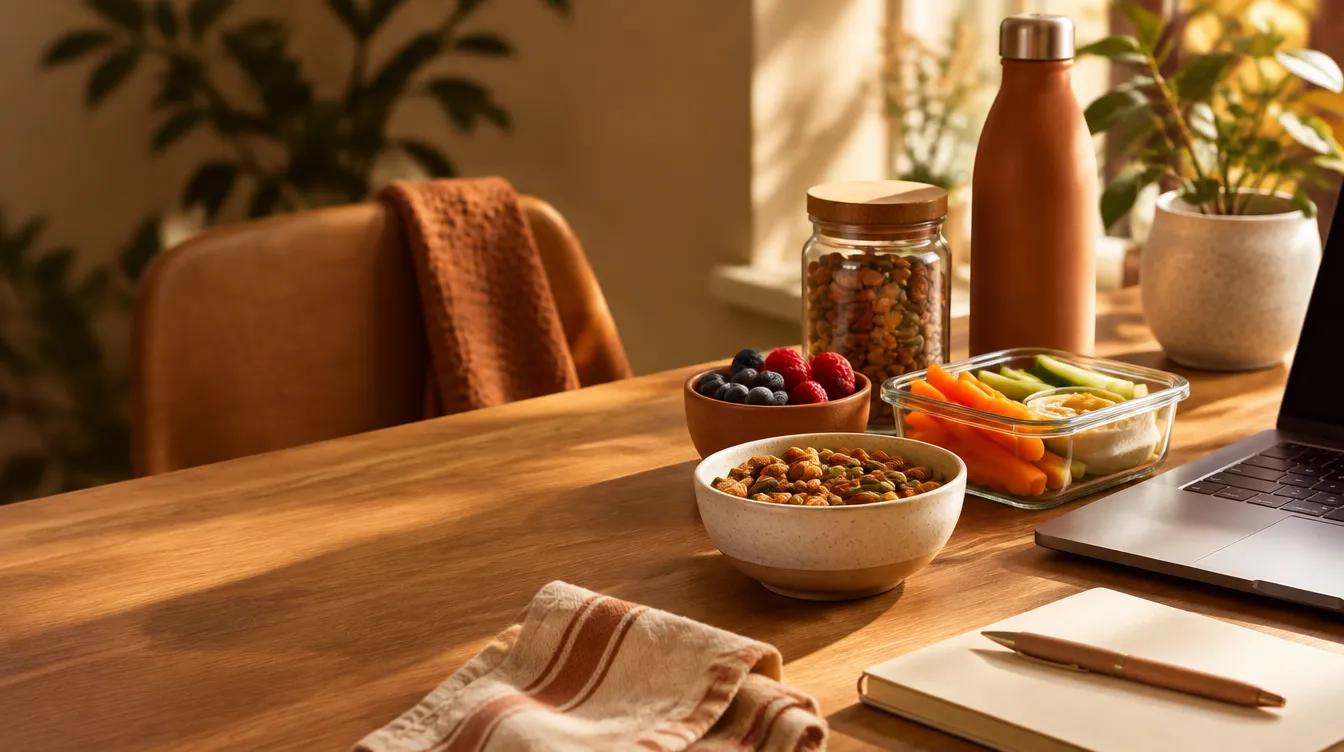
Quick answer: Snacks that don’t spike blood sugar are the ones where you know the total carbohydrate in the portion you actually eat — not the claim on the front of the package. Build a small desk stash, pack counted portions, pair carbs with protein or fat, and keep a backup plan for the days a meeting runs late.
The afternoon snack decision usually happens at the worst possible moment: lunch is long gone, the next meeting is running late, and the vending machine is closer than anything you packed. For someone newly diagnosed with type 2 diabetes, that moment can feel like a test you never studied for.
This guide takes the pressure off. The goal is not a perfect snack — it’s a small set of workable options you prepared in advance, with carbohydrate amounts you already know. Everything here is educational and works alongside the guidance your care team has given you; their instructions about portions and targets always come first.
What snacks don’t spike blood sugar?
Quick answer: there is no universally “safe” snack — what matters is the total carbohydrate in the portion you actually eat, plus what it’s paired with (source: the CDC). Whole grain crackers with cheese, an apple with peanut butter, plain Greek yogurt with berries, and baby carrots with hummus are practical starting points that travel well to a desk.
The front of a package is written to describe the product, not to answer your questions. “Low sugar” or “made with whole grains” says nothing about the total carbohydrate in the amount you plan to eat. A snack that fits your plan is one where you turned the package over, checked the label, and know the number for your portion.
No food predicts a specific glucose result — your response and your care team’s guidance matter more than any general claim. But preparation beats willpower: a short list of options you like, can carry, and can count makes the afternoon feel like a decision you prepared for, not a test.
How do you read a snack label for carbs?
Quick answer: read three items in order — serving size, servings per container, then total carbohydrate (source: the ADA). Skip the front-of-package claims until after that sequence.
A label check takes about a minute once you know the order:
- Serving size. This is the amount the label’s numbers describe — not a recommendation about how much you should eat. If it says 14 crackers, and you’re planning 14 crackers, the math is easy. If it says 7 and you eat the whole pouch, the listed carbohydrate line doesn’t describe what you ate.
- Servings per container. A small pouch can hold two or more servings. Reading the carbohydrate line without this line is the most common way a “small snack” quietly doubles.
- Total carbohydrate. This is the number that matters for your plan — more than sugar alone, because all digestible carbohydrate counts toward your portion.
Do this check before hunger arrives. On a quiet morning, read the label of a snack you already keep in your bag or desk drawer. No scale or app needed to start — just connect the label’s measure with the food in front of you, and write down the carbohydrate amount for the portion you plan to pack.
If your next appointment is coming up, the checklist of tests and questions worth asking is one page you can print — A1C, the kidney tests, and the four questions about your results.
How much should you pack — and how do you count it?
Quick answer: the portion you pack is the portion to count. If your portion differs from the label’s serving size, use the label to work out the carbohydrate for the amount you’re actually bringing, and record it.
The label’s serving size is a reference point, not an instruction. If you plan a smaller or larger portion, scale the carbohydrate number to match — half the serving means half the listed carbohydrate, a serving and a half means one and a half times. Write that number on the package or in a note on your desk. A snack you can count in ten seconds is a snack you’ll actually use on a busy day.
This is also where pairings help: adding cheese, peanut butter, or hummus to a smaller portion of crackers, fruit, or vegetables gives you a snack that feels satisfying without resting entirely on the carbohydrate amount.
Which snack pairings travel well to work?
Quick answer: pairings that are findable, enjoyable, portable, and countable. Practical starting points:
| Familiar food | Possible pairing |
|---|---|
| Whole grain crackers | Cheese |
| Apple | Peanut butter |
| Plain Greek yogurt | Berries |
| Baby carrots | Hummus |
These are starting points, not universal recommendations. A pairing earns its place on your list only if it works on an ordinary workday: it fits your preferences, survives the commute, and respects any refrigeration or allergy limits you have. If one option is unavailable or unappealing, swap the food rather than talking yourself into something you don’t want.
The aim is variety with backups, not a complete grid. Two or three combinations you genuinely like — each with a counted portion — are worth more than a long list of theoretical options.
What do you eat when the vending machine is the only option?
Quick answer: work through your backup slots before settling: the desk stash, then the bag snack, then the late-meeting backup. If the vending machine is truly the only choice, pick the option closest to a counted portion you know, eat the portion you decided in advance, and move on.
A backup plan isn’t a prediction that the day will go wrong — it’s a way to keep one disruption from leaving only the vending machine option. The three-slot plan covers the real failure points of a workday:
- Desk stash. Shelf-stable, counted options within reach of your desk.
- Bag snack. For days you’re in meetings or away from your desk.
- Late-meeting backup. For the moment lunch is gone, the meeting runs long, and you can’t reach either of the first two.
When a plan fails, start with the slot that changed: if the bag snack is missing, check the desk stash; if you’re stuck in a meeting, the backup needs to be on you, not in a drawer across the office. And if the vending machine wins the day, one unplanned snack is a data point, not a verdict — the pattern over weeks is what matters, and knowing what you ate and roughly how much carbohydrate it carried keeps the data useful.
How do you keep the snack plan working as your routine changes?
Quick answer: review the plan when your schedule shifts — new office, new meeting rhythm, new medications — and re-check labels when products change. A plan that survives is one you revise instead of abandon.
Snack plans fail quietly: a product gets reformulated, a stash item goes stale, a new meeting block deletes your lunch break. Every few weeks, spend five minutes re-reading the labels on what you actually keep, restocking the three slots, and retiring anything that no longer fits. The plan is meant to serve your routine — as your routine changes, the plan changes with it.
Free 21-snack guide
Between-meal snacking is where most of the hidden sodium lives: crackers, cheese, chips, deli meat, frozen bites. The free 20-page guide lists 21 snacks that land at or under 140 mg a serving, each with the honest catch (potassium, portion size, the label trap), plus the five-second label check and a one-page shopping list. Download the free 21-snack guide — 20 pages, no signup.
Frequently asked questions
Do I have to give up snacks completely with type 2 diabetes? No. Snacking isn’t forbidden — the useful skill is knowing the carbohydrate in the portion you eat. A counted portion of something you enjoy, paired with protein or fat, usually fits a plan better than skipping snacks until hunger makes the decision for you.
Is “sugar-free” the same as carb-free? No. Sugar-free products often still contain total carbohydrate from grains, starches, or milk, and the label’s carbohydrate line — not the front claim — is what counts toward your portion. Always check serving size and total carbohydrate together.
What’s a good snack for a late meeting? Something shelf-stable, already counted, and on your person — not in a drawer across the office. Nuts, a small portion of whole grain crackers with a counted carbohydrate note, or a nut-based bar whose label you’ve already read all work as late-meeting backups.
How many carbs should an afternoon snack have? There’s no universal number — the right range depends on your meal plan, medication, and your care team’s guidance. What this guide contributes is the method: decide the portion in advance, count its carbohydrate from the label, and record it so the decision is already made when hunger arrives.
Does protein or fat with a snack help? Pairing carbohydrate with protein or fat — cheese with crackers, peanut butter with apple — is a practical way to make a smaller carbohydrate portion more satisfying. It doesn’t predict a specific glucose result; your response and your care team’s advice matter more than any general pairing claim.
What if I ate something unplanned? Note what it was and roughly how much carbohydrate it carried, then return to your next planned slot. One unplanned snack doesn’t undo a plan — treating it as data instead of failure is what keeps the habit alive.
This article is educational content, not medical advice. Work with your healthcare provider on targets, portions, medication, and any concerns about your blood glucose.
There’s also a free companion checklist, Portable Desk Snacks with Counted Carbs — download it free →.
This guide is also available in Spanish: Snacks que no disparan la glucemia: un plan de cajón.
Want the complete system?
This guide is based on Hardy's ebooks — plain-language, step-by-step PDFs you can read in one sitting. See all guides
Educational content only — not a substitute for advice from your doctor or pharmacist. Always work with your care team.